For a fleeting moment, the digital battlegrounds witnessed a seismic shift in power. In the waning days of August, the landscape of Steam's concurrent player hierarchy was redrawn, not by a seasoned monarch, but by a young, relentless challenger. PlayerUnknown's Battlegrounds, a phenomenon barely five months into its early access life, achieved what many considered unthinkable: it temporarily surpassed the perennial titan, Dota 2, in concurrent players. This was not a mere statistical blip but a symbolic passing of the torch, a testament to a new genre's visceral pull. Like a sudden summer storm that briefly eclipses the sun, PUBG's surge cast a new shadow over the platform, its player count swelling to overtake Valve's flagship by approximately 30,000 souls. The servers, strained by this unexpected coronation, would later buckle under the weight of its own success, but the message was already etched into the annals of gaming history: a new era of player engagement had dawned.
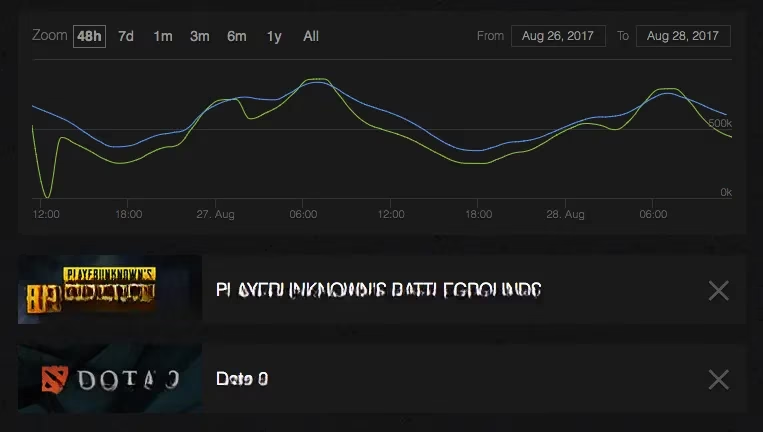
This victory was the culmination of a meteoric ascent. Before this historic overtake, PUBG had already cemented itself as the most-played non-Valve title on Steam, a silver medalist perpetually in the shadow of Dota 2's gold. Its journey from curious early-access experiment to a contender for the throne was as rapid as it was decisive. The achievement arrived on a wave of monumental news: the game had sailed past the 8-million sales mark, and its creator had begun teasing the community with visions of a new, mysterious map. The player base, already massive and fervent, was given new worlds to imagine and new reasons to log in. The game's infrastructure, however, sometimes trembled like a spider's web under a heavy dew, struggling to hold the immense and sudden weight of its popularity.
The context of this player-count duel is essential. Neither game reached its absolute, all-time concurrent peak during these skirmishes. It was a battle for the current crown, the daily sovereignty of Steam's charts. Dota 2, a behemoth refined over years, represents the strategic, deep-end mastery of the MOBA genre—a complex clockwork of spells and strategy. PUBG, in stark contrast, offered a raw, unpredictable survival thriller. Its appeal was primal and immediate; it was a hundred-player story generator where each match was a unique, pulse-pounding narrative. Surpassing Dota 2 was akin to a wild, untamed river briefly overflowing the banks of a grand, ancient canal. The canal's flow is constant and engineered, but the river's power is ferocious and natural.
PUBG's rise was underpinned by consistent evolution. Earlier in the month, the developers had rolled out first-person servers for all game modes, fundamentally altering the perspective and intensity of the experience for purists. Furthermore, a monthly update introduced support for Xbox controllers, a clear signal of the game's ambition beyond the PC master race and a nod toward its impending console future on Xbox One. These were not just patches; they were the building blocks of an empire, each one carefully placed to broaden the game's appeal and solidify its mechanics. The community responded not just with playtime, but with a cultural footprint. IGN's collection of crazy stats from developer Bluehole—detailing kill counts, weapon preferences, and more—painted a picture of a game that was as analytically fascinating as it was viscerally thrilling.
What does this transient dominance signify for the landscape of 2026? It foreshadowed a diversification of what "top game" means. No longer was it solely the domain of legacy franchises or pure competitive esports. A game could reign through sheer, chaotic, social momentum. PUBG's model—a tense, last-man-standing spectacle—proved to be as compelling to watch as it was to play, fueling a content creation ecosystem that itself fed the player count. Its victory was a bloom of neon fungus on the ancient oak of Steam's ecosystem, brilliant, fast-growing, and indicative of a new kind of vitality. While Dota 2's community remains a bedrock of stability, PUBG demonstrated the explosive potential of a novel formula executed with gripping precision.
Ultimately, the throne was contested, not permanently seized, in those August days. The servers stabilized, player counts returned to their habitual rhythms, but the precedent was set. PlayerUnknown's Battlegrounds had proven it could look a giant in the eye and, for a glorious moment, stand taller. It announced that the appetite of the gaming multitude could shift with dramatic speed, embracing new worlds where every corner could hide a tale of triumph or defeat. The battle for concurrent supremacy was no longer a two-horse race but a vibrant, unpredictable melee, with a hungry newcomer having drawn first blood.
| Aspect | Dota 2 (The Incumbent) | PUBG (The Challenger) |
|---|---|---|
| Genre | MOBA (Multiplayer Online Battle Arena) | Battle Royale / Survival Shooter |
| Core Appeal | Deep strategy, team synergy, mastered skill | Survival tension, unpredictable narratives, instant action |
| Metaphor | A grand, ancient chess tournament | A hundred-person hunt in a shrinking, electrified arena |
| Growth in 2026 Context | Steady, foundational, esports-centric | Explosive, trend-setting, community & streamer-driven |
In retrospect, that brief window was more than a statistical anomaly. It was a cultural moment—a signal flare showing that the players' collective heart could beat fastest for a game where the only rule was to be the last one standing. The echoes of that August surge would resonate for years to come, inspiring a generation of developers and forever altering the metrics of success in the digital playground.