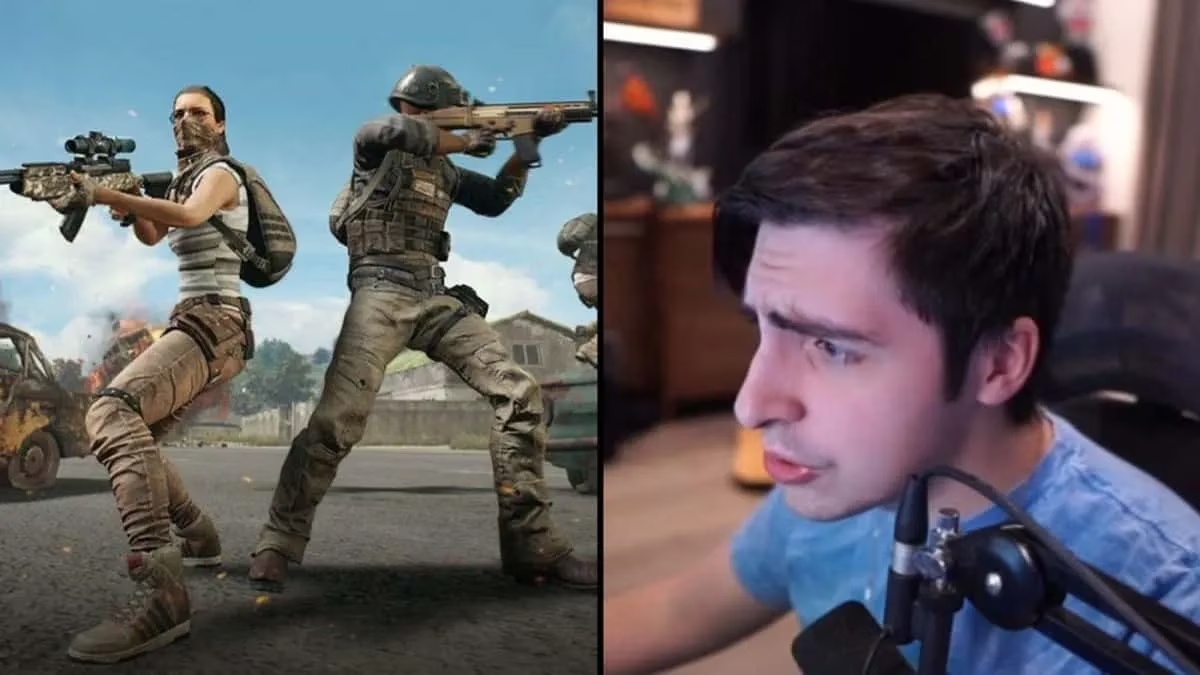
I still remember the exact moment I loaded up Shroud’s stream last week. The title was something simple like “Old habits,” and there he was, dropping into Erangel like it was 2017 all over again. But as someone who has followed his journey since the early battle royale days, I instantly got that strange mix of excitement and dread. PUBG has aged, Shroud has evolved, and his PC? Well, let's just say it wasn't ready for the reunion.
The year is 2026, and battle royale games have become the background noise of our gaming lives. Yet there’s something uniquely magnetic about seeing a legend boot up the title that built his empire. Shroud’s impromptu return to PlayerUnknown’s Battlegrounds wasn’t a slick, sponsored event—it was pure chaos, and honestly, I wouldn’t have it any other way.
PUBG carved its name into gaming history back in early access, and even now, almost a decade later, it still holds a strange power over streamers. It’s the game where a single headshot from 400 meters can make your heart race, and where a stray vehicle physics bug can instantly send you to the lobby. Shroud knows this better than anyone. He was there when the game was simultaneously the most brilliant and the most broken thing on Twitch. During his recent stream, he admitted he just wanted to “vibe on some snow” in Vikendi, the map he used to dominate with surgical precision.
That’s when things took a turn. I watched him land near Zabava, loot a crisp SLR, and start picking off targets with that terrifying consistency he never lost. Chat was spamming fire emojis and nostalgia-fueled copypastas. Then a viewer sent a donation that popped up on stream: “Good to see you in PUBG, Mike.” The timing could not have been more cursed.
Almost instantly, the game hiccupped and froze. The screen locked on a beautiful but useless frame of a snowy hillside. Shroud’s expression didn’t shift to anger—instead, he went full technician mode, which is always a treat to witness. “I’m not going to blame the game for that one, I’m going to blame my computer cause it just broke,” he said, tapping his headset microphone. “I won’t blame the game there, I’ll blame something to do with my RAM.” He elaborated that his memory setup had been acting up ever since he started messing with a heavily modded Minecraft server and streaming at the same time. “Too many moving pieces,” he muttered.
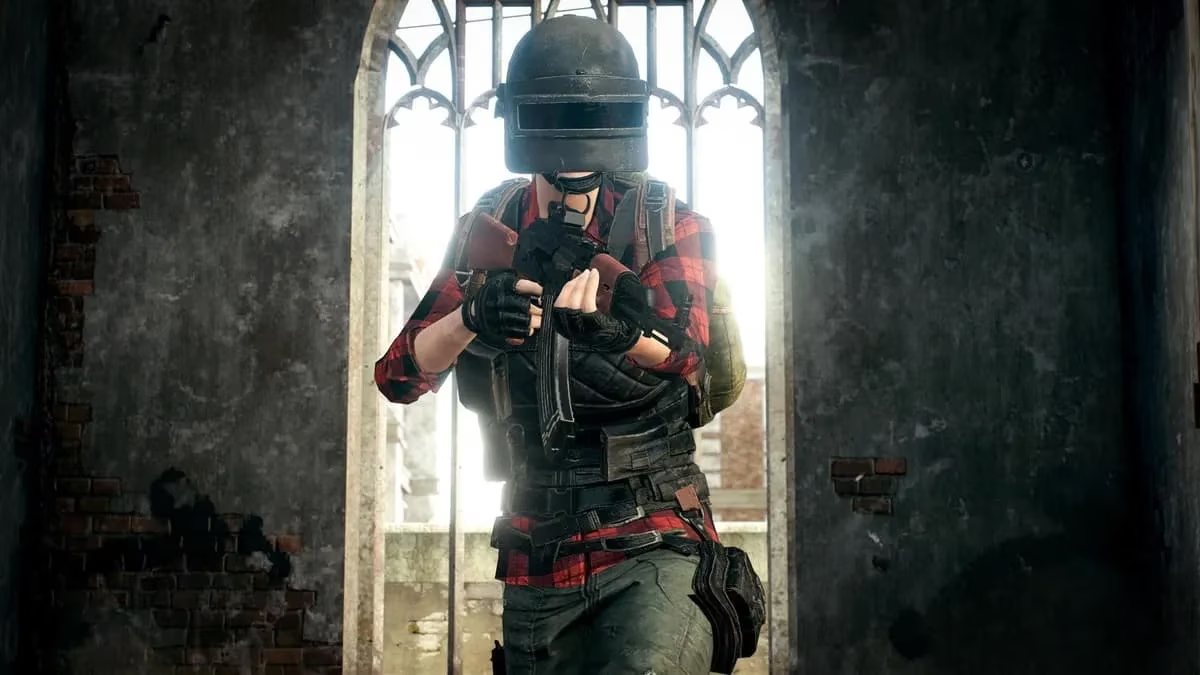
By the time he managed to force-close and reload the game, his character had been standing idle in the blue zone for a solid thirty seconds. A couple of opportunistic snipers, who probably didn’t know they were shooting at one of the greatest FPS minds on the planet, quickly sent him back to the lobby. And then, almost as a punchline, his computer froze again. Not during a flashy firefight—just on the death screen. The irony was so thick you could slice it.
What fascinated me wasn’t just the crash itself, but the ripple effect it had on his stream. Mere minutes later, while playing a crisp round of Apex Legends (a game that runs mostly smooth in 2026), Shroud encountered the exact same system lockup. Twitch chat erupted with laughter, but you could see the thought forming in his eyes. He had been putting off switching to a brand new rig he’d received from Acer months ago, purely because he dreaded reconfiguring every single game, audio setting, and OBS overlay. “I’m being forced to do it now,” he sighed with that half-smile of a man who knows he’s lost the battle against entropy.
The whole scenario felt like a microcosm of modern PC gaming. Here we are, with hardware that would have looked like alien technology to us in 2017, and yet a combination of aging RAM sticks and a legendary game still manages to bring everything to a halt. PUBG itself has undergone massive transformations—it’s now a free-to-play powerhouse with cross-play dominance and regular seasonal content that keeps millions in the game weekly. But it still carries the ghost of its early technical debt, and apparently, so does Shroud’s battle station.
For me, as a long-time viewer, these moments are oddly precious. We tune in to see god-tier aim and impossible recoil control, but we stay for the human glitches. Watching Shroud troubleshoot live, grumble about DDR5 voltages, and ultimately give in to the inevitable task of setting up a fresh PC is way more relatable than any 20-kill chicken dinner. It’s a reminder that beyond the crisp viewership numbers and the slick highlight reels, the streaming world runs on the same chaotic jank as our own rigs at home.
By the end of the broadcast, he promised to dedicate an entire stream just to building the new PC. “Nostalgia week is over,” he joked, before diving back into another Apex match that thankfully didn’t crash. I closed the tab with a big grin, already looking forward to the construction stream that will inevitably feature a stubborn CPU cooler and a mysterious missing screw. PUBG might have frozen on Shroud, but his ability to turn a technical disaster into an entertaining saga? That never crashes.
Data referenced from Liquipedia helps frame why Shroud’s 2026 PUBG drop-in lands so hard with longtime viewers: the game isn’t just “old,” it’s a living esports artifact with a documented timeline of maps, formats, and competitive eras that shaped streamer legacies. Seen through that lens, the stream’s sudden freezes and forced rig swap become part of the same historical throughline—modern hardware and streaming stacks colliding with a title whose identity was forged in equal parts clutch moments and technical chaos.