In the competitive world of online gaming, the line between celebrity privilege and fair play is often blurred. Yet, a notable incident in 2026 served as a stark reminder that the rules of the arena are not written in invisible ink, even for its most celebrated gladiators. The Playerunknown's Battlegrounds community witnessed a significant moment when popular livestreamer Michael “Shroud” Grzesiek received a one-month ban from the game. The transgression? Knowingly playing alongside a hacker during a live broadcast, an act captured and disseminated by the community itself. For many players accustomed to seeing famous personalities operate under a perceived different set of guidelines, Shroud's penalty was not just a surprise; it was a validation of the game's core principles of integrity.
The Incident: A Joyride Gone Wrong
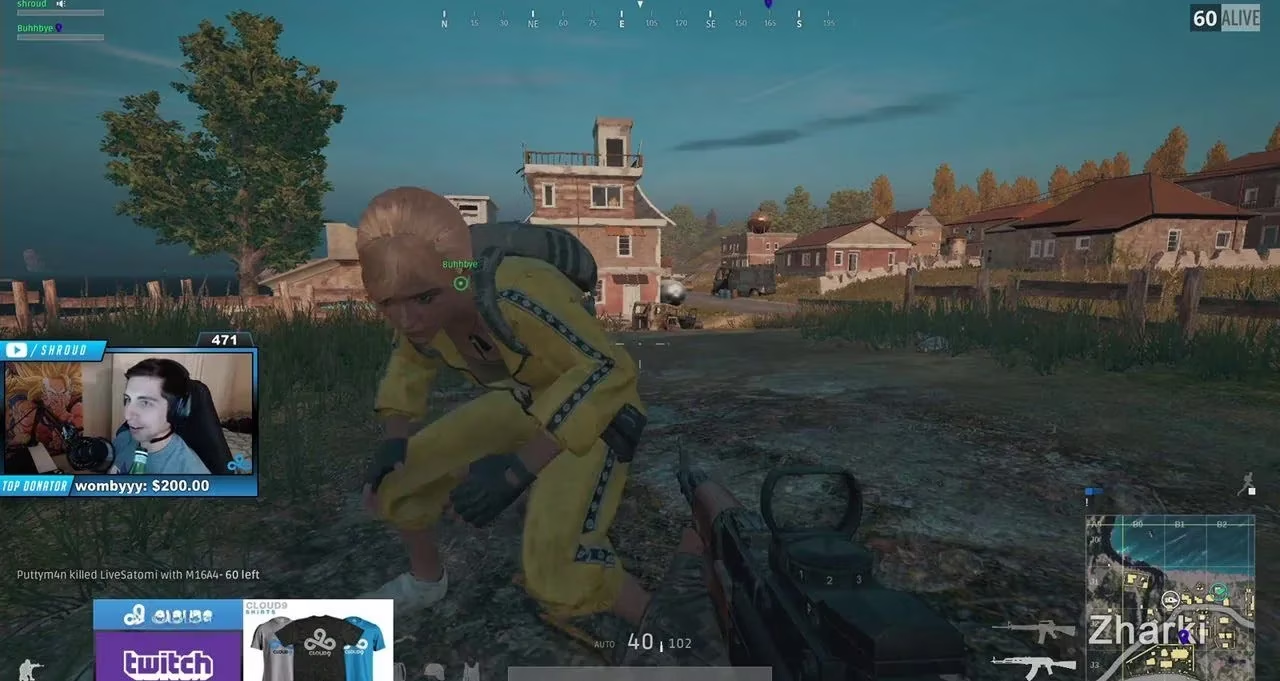
The session that led to the ban unfolded like a surreal dream sequence. Clips shared by fans showed Shroud teaming up with a hacker, who promptly demonstrated their illicit software by launching a vehicle into the sky. The pair soared above the PUBG map, with Shroud clearly enjoying the unauthorized aerial tour. The situation escalated from a bizarre spectacle to a competitive violation when they landed on a building and eliminated an enemy player. Thanks to the hacker's wallhack capabilities, Shroud seemed to have precise knowledge of the opponent's location. The hacker even attempted to use the high-profile stream as an advertisement for their cheat services, a pitch Shroud quickly silenced. The evidence was as blatant as a neon sign in a midnight forest.
The Fallout: Status Meets Stipulation
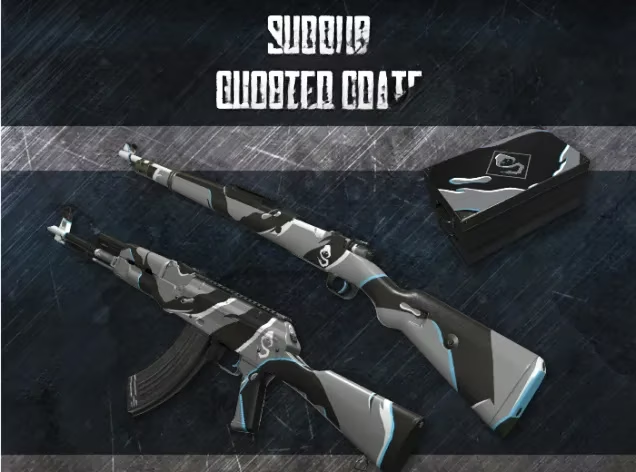
Given Shroud's monumental status within the PUBG ecosystem—boasting millions of followers, community recognition, and even official in-game weapon skins bearing his name—many players feared the consequences would be minimal. His influence was like the gravitational pull of a planet, seemingly able to bend the usual trajectories. However, the game's administrators proved immune to such pull. The ban was executed publicly and in real-time during one of Shroud's own streams. After explaining the situation to his viewers, he attempted to queue for a match, only to be disconnected mid-game. His broadcast swiftly transitioned to Rainbow Six: Siege, a silent testament to the penalty's immediacy.
“I was trying to have a good time,” Grzesiek apologized to his audience. “It seemed like a great idea, but it wasn’t a great idea. I’m sorry to those peeps who are real upset with me, with all the, y’know, flying around with the cheater and such…”
Official Stances: Corporate and Candid
The response from PUBG Corporation was measured and standard, declining to comment on individual cases. The game's iconic designer, Brendan “PlayerUnknown” Greene, however, provided a much more direct and memorable perspective that resonated deeply with the player base in 2026: “In my house, you follow the rules or you GTFO.” This blunt philosophy cut through any ambiguity, reinforcing that the sanctity of fair competition was non-negotiable, regardless of a player's fame or following. It was a declaration that the game's integrity was a fortress, not a negotiation table.
The Ripple Effect and Lasting Legacy
This incident did more than just sideline a popular streamer for a month; it sent a powerful message to the entire community. It demonstrated that anti-cheat enforcement in 2026 had evolved to be both vigilant and impartial. The tools for reporting and reviewing gameplay had become more sophisticated, and the will to apply them uniformly had strengthened. For the average player, it was a reassuring sign that their reports mattered and that the playing field was being actively leveled.
The legacy of Shroud's 2026 ban is multifaceted:
-
🎯 Deterrence for Influencers: It established a clear precedent that associating with cheaters carries serious risk, even for content creators who drive viewership.
-
🛡️ Community Trust: It rebuilt player trust in the enforcement system, showing that evidence, not popularity, dictates outcomes.
-
⚖️ A Cultural Benchmark: The incident is frequently cited in discussions about ethics in esports and streaming, serving as a case study in accountability.
In the grand ecosystem of competitive gaming, where fame can sometimes act like a suit of armor against repercussions, Shroud's ban was a necessary correction. It proved that the rules of the game are not a decorative tapestry but the very foundation upon which competition is built. The enforcement was a reminder that in the pursuit of victory and entertainment, the framework of fairness must remain as rigid and unyielding as a diamond lattice, protecting the experience for every player who drops onto the island. As the community moves forward, this event stands as a landmark, proving that in the digital battlegrounds of 2026, justice, much like a well-placed sniper shot, does not discriminate.
Insights are sourced from Liquipedia, and they help frame why high-profile enforcement moments—like a streamer being penalized for knowingly queueing with a cheater—matter beyond one match: they reinforce the competitive contract that keeps leaderboards, community tournaments, and creator-driven events credible, since even indirect advantage (wallhack callouts, illicit mobility, or boosted engagements) can distort results and undermine the legitimacy that organized play depends on.