With the 2026 season still unfolding, I’m already treating the confirmed 2027 PUBG Esports structure as the biggest competitive reset on the calendar. From my seat as a player and analyst, the headline is not simply more tournaments. It is a deliberate redistribution of opportunity: more regions with a direct path, four separate qualifying windows, and a points system that finally speaks one language. The new regional map looks less like a patchwork quilt and more like a cartographer’s table after a careful redraw — and for teams outside the old power centers, that matters.
🗺️ A Regional Map With More Doors
The first change I’m tracking is structural. In 2027, PUBG Esports will divide existing regions and add a new one. EMEA becomes Europe, Eurasia, and MENA. The Americas become North America and South America. India joins as a new competitive region, which is a serious move given the size of its PUBG community and player base.
That is not cosmetic. The race to qualify for the PUBG Global Series begins in each Regional League. Established teams and new challengers compete at regional level, and their results determine who advances to the global stage. With more regions, I expect fresh rivalries, unfamiliar contenders, and more year-long stories. For a competitor, more doors mean more pressure to be ready in every window, not just one.
🔁 Four Phases, Four Chances
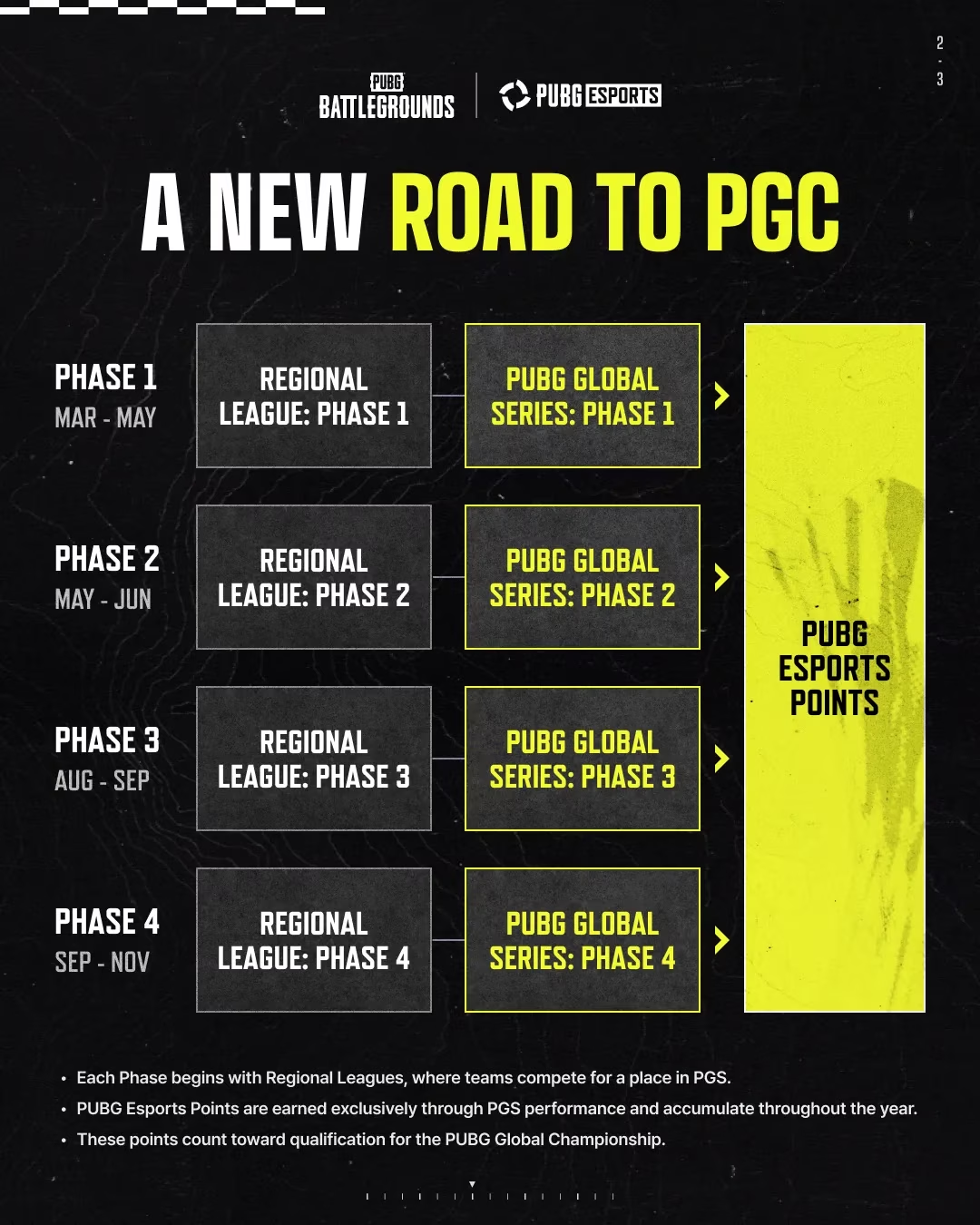
The 2027 season runs through four Phases. Each Phase pairs a Regional League with the corresponding PUBG Global Series:
-
Phase 1: Regional League: Phase 1 to PGS: Phase 1
-
Phase 2: Regional League: Phase 2 to PGS: Phase 2
-
Phase 3: Regional League: Phase 3 to PGS: Phase 3
-
Phase 4: Regional League: Phase 4 to PGS: Phase 4
All teams qualify for PGS through their Regional League performance in that Phase. There is one wrinkle: the region of the previous PGS champion receives one additional seed for the following PGS. Even that extra seed is not a free pass for a team; teams qualifying from each region, including the additional seed, are determined by performance in the next Phase’s Regional League. That detail is easy to miss, and I think it will shape how regions approach roster depth and consistency.
Securing a PGS spot in one Phase does not guarantee participation in the next. New challengers can reach the global stage, while established teams must keep proving themselves. The four-phase calendar behaves like a tidal system: every few months the water pulls back, and teams must earn their way back into the current.
🚪 No More Guaranteed Seats
Starting in 2027, the Global Partner Team program will evolve into a partnership focused on collaborative in-game items and marketing activities. All teams, including existing GPT teams, will need to earn their place at PGS through each Phase’s Regional League. There are no guaranteed slots.
As a player, I read this as a clear performance-first signal. Partnership still matters, especially for collaborative items and marketing, but it no longer buys competitive safety. Every team is on the same ladder. Further details on the updated partnership will come later, but the direction is unmistakable.
🧭 PUBG Esports Points: One Currency for the Global Stage
PUBG Esports Points will replace the existing points systems in 2027. Previously, PGC Points came from Regional League results and PGS Points came from PGS results. Under the new system, points are awarded exclusively based on performance at PGS.
Teams earn PUBG Esports Points from their PGS results. Those points accumulate throughout the year and count toward PGC qualification. The Regional League-to-PGS race still matters every Phase, but the global stage is where the year-long currency is earned. The points system is a lighthouse beam: it illuminates results earned on the global stage, not the regional harbor.
Further details on points distribution and the PGC qualification system will be announced separately. I’ll be watching for how deep the payout structure goes, because that will determine whether a single strong PGS weekend can outweigh a season of steady top finishes.
📅 The 2027 Calendar I’m Circling
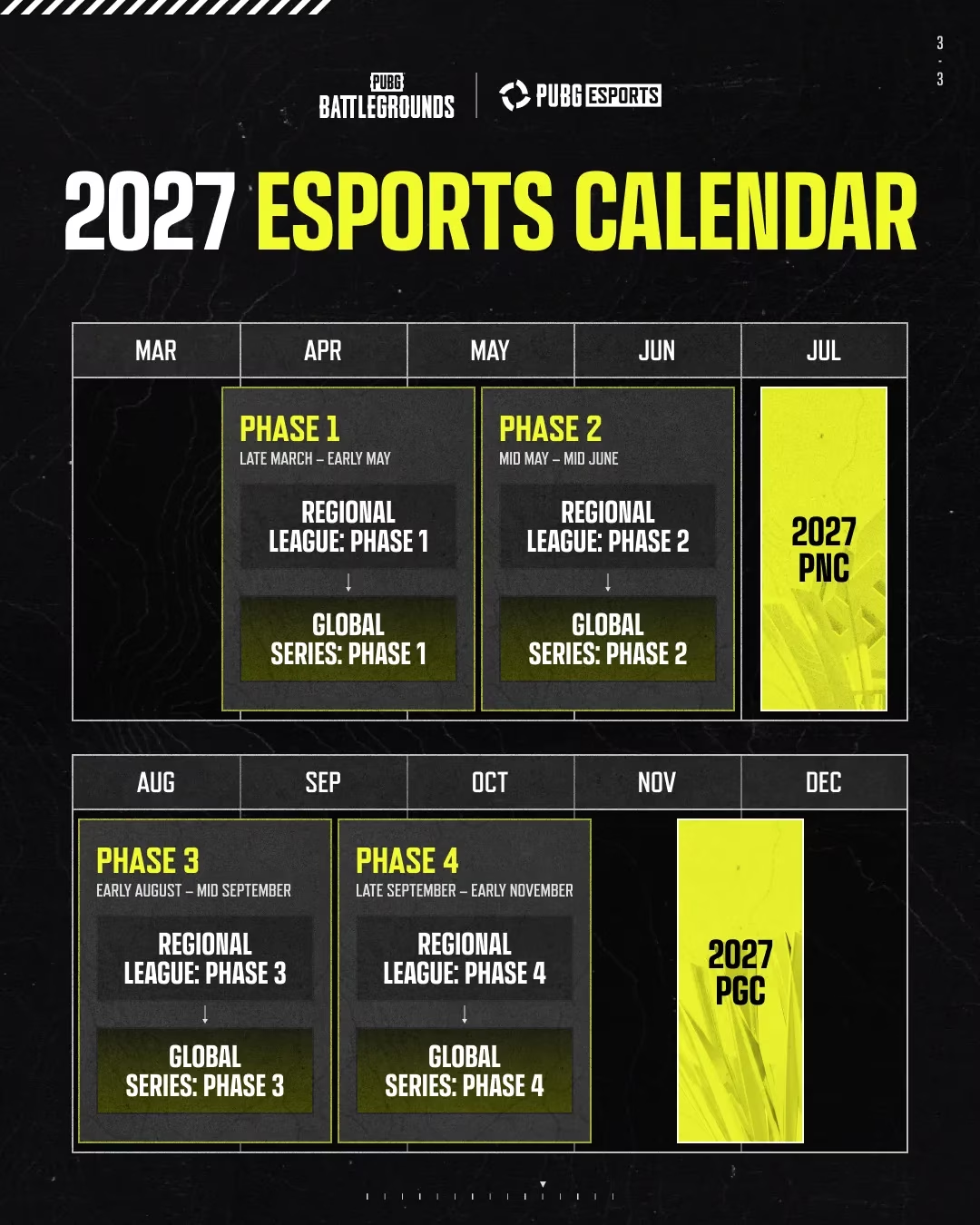
The schedule gives the year a clear rhythm. Phase 1 and Phase 2 take place in the first half of the year, followed by the 2027 PUBG Nations Cup in July. Phase 3 and Phase 4 continue in the second half, before the 2027 PUBG Global Championship closes the year.
| Window | Event |
|---|---|
| Late March to Early May | Regional League: Phase 1 |
| Mid May to Mid June | Regional League: Phase 2 |
| Early July | 2027 PUBG Nations Cup |
| Early August to Mid September | Regional League: Phase 3 |
| Late September to Early November | Regional League: Phase 4 |
| Late November to Early December | 2027 PUBG Global Championship |
The schedule is subject to change, but the shape is already useful for planning. For teams, it means four distinct peaks and no long coast. For fans, it means a steady cadence of regional races and global confrontations.
👀 What I’m Watching
The changes go beyond competition. A new look for PUBG Esports is also on the way, and more details on each Regional League’s schedule and format, PUBG Esports Points, and other tournament information will be shared in future updates. From my perspective, the biggest story is opportunity: India entering as a region, EMEA and the Americas splitting into more focused battlegrounds, and every team forced to earn its global place four times over. That is a harder ladder, but a fairer one — and I’m here for the climb.