As a PUBG Esports follower, I still keep the PUBG Continental Series 5 briefing in my reference file in 2026. PCS5 is not the current tournament cycle, but it remains a useful case study for how PUBG Esports turns regional competition into a global pathway. The fifth PCS was a crucial global event because teams fought for precious points required to advance to the PUBG Global Championship later that year. In 2026, that logic still shapes how I evaluate any continental series: regional depth, transparent prize distribution, and fan participation are not side details; they are the product.
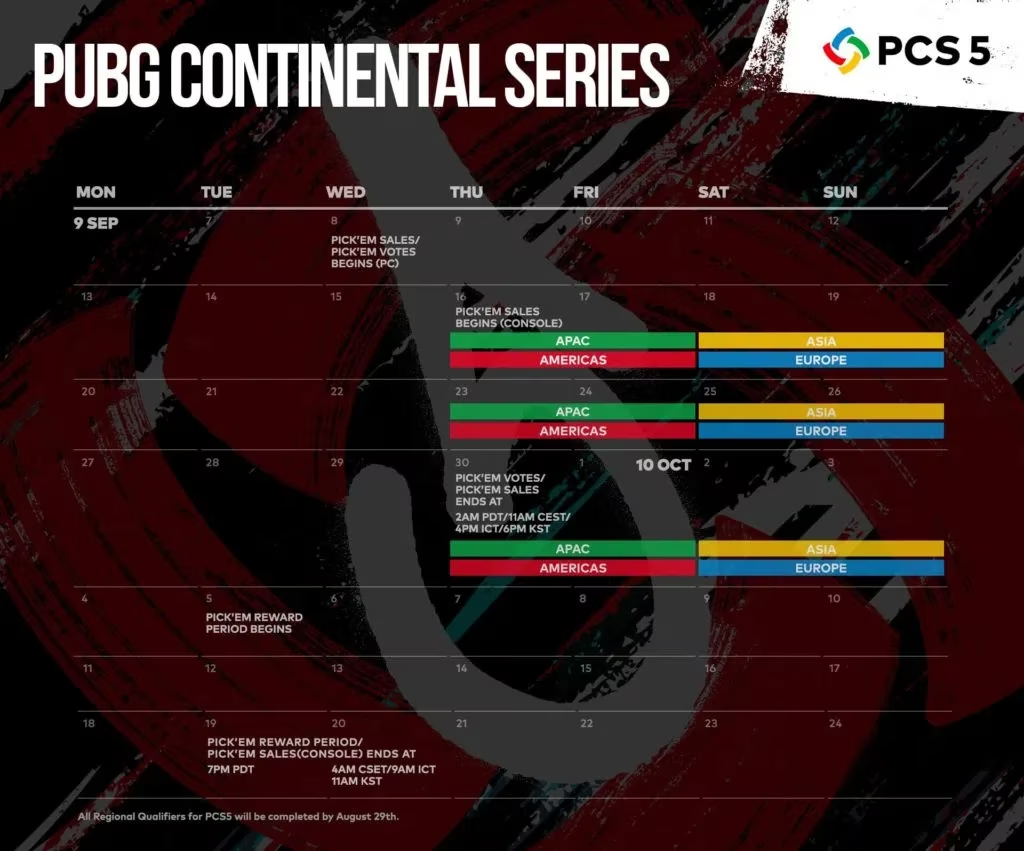
PCS5 was held across four regions. Asia covered Korea, Japan, China, and Chinese Taipei. Asia Pacific covered Southeast Asia and Oceania. The Americas covered North America and Latin America. Europe covered Europe, the Middle East, and Africa. The schedule was split into two regional blocks, which I still think was smart for viewers who wanted to follow multiple storylines without losing track of the global race.
| Regional block | Regions | Match dates |
|---|---|---|
| Asia Pacific and Americas | Southeast Asia, Oceania, North America, Latin America | September 16-17, September 23-24, September 30-October 1 |
| Asia and Europe | Korea, Japan, China, Chinese Taipei, Europe, Middle East, Africa | September 18-19, September 25-26, October 2-3 |
What makes PCS5 worth revisiting is the prize structure. The PCS5 prize pool started at 1 million USD, split evenly across the four participating regions. Similar to previous events, 30% of all PCS5 item sales contributed toward the total prize pool via crowdfunding. Each region started with a base prize pool of 250,000 USD, and 30% of PUBG's net sales of PCS5 items was shared directly with participating teams. The published line items I noted were a basic prize of 230,000 USD, Week 1 at 60,000 USD, Week 2 at 70,000 USD, Week 3 at 100,000 USD, and special prizes at 20,000 USD.
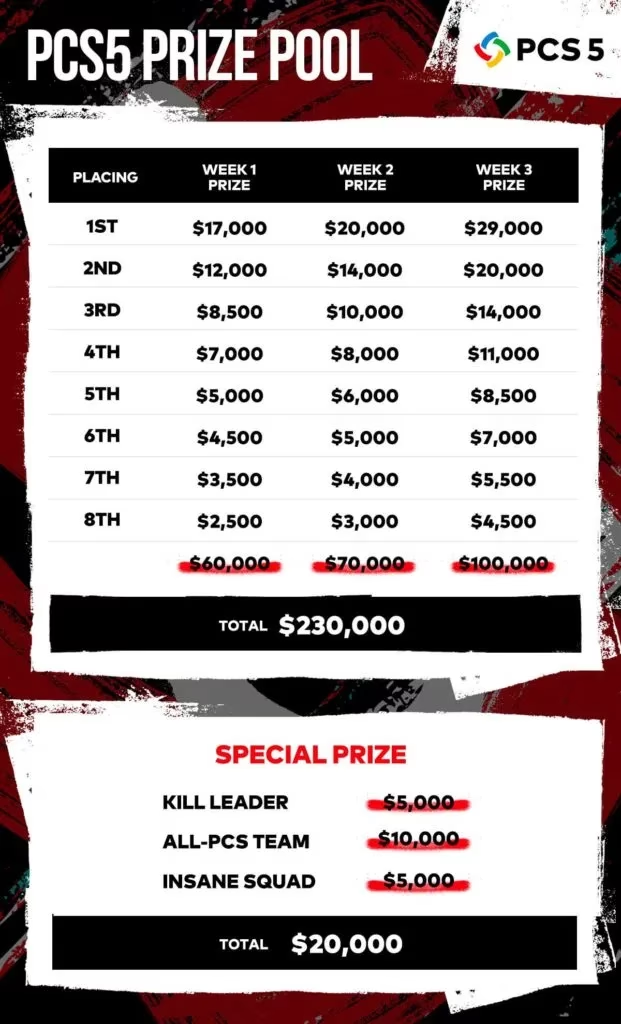
The special prizes gave PCS5 extra texture. The Kill Leader award was worth 5,000 USD and went to the player with the most kills, with the prize distributed evenly in the case of a tie. The All-PCS Team award was worth 10,000 USD and went to the four best performing players in the series. The Insane Squad award was worth 5,000 USD and went to the team that showed the most impressive moment in the series. Winners of the special prizes were carefully chosen by the selection group. I like this because it rewards both raw statistics and highlight-reel impact, which are two different kinds of value in battle royale esports.
The Pick'em Challenge event returned with PCS5. The PCS5 item sales period ran for PC from September 8, 2021 to September 30, 2021 at 1700 KST, and for console from September 16, 2021 at 1100 KST to October 20, 2021 at 1100 KST. The event also included a PCS5 Pick'em Challenge period, a PCS5 Pick'em reward claiming period, and an esports shop sales period. From a 2026 perspective, I see Pick'em as an early example of how PUBG Esports blended live viewing with in-game participation. It gave fans a reason to care about regional matchups beyond their own region.
There are three lessons I still take from PCS5 in 2026. First, a continental series works best when it has a clear global consequence. PCS5 was not just a regional final; it was a stepping stone toward the PUBG Global Championship. Second, crowdfunding can make the prize pool feel shared rather than imposed from above. Third, a mix of weekly prizes, player awards, and team awards creates more narratives than a single winner-takes-most table.
I do not treat PCS5 as breaking news in 2026. I treat it as a blueprint. The names and dates belong to 2021, but the structure still speaks to the current PUBG Esports audience: four regions, one global ladder, and a fanbase that wants to watch, pick, and participate. That is why I still study PCS5, and why I expect future continental events to keep building on the same competitive DNA.