If you're trying to figure out how to get Artisan Tokens in PUBG, here's the fast version: in PUBG: BATTLEGROUNDS during the 2026 store cycle, Artisan Tokens mostly come from collab-event Special Crafting, not from the regular store and not from standard Contraband Crates. You usually need to collect a collaboration's event currency first — like aespa Tokens or Stellar Blade Tokens — and then trade those in for an Artisan Token x100 bundle inside the Workshop. That odd setup is exactly why so many players get confused.
The system applies across both PC and console, and it sits squarely inside the Workshop economy. So if you've been checking the main shop and wondering why you can't just buy Artisan Tokens outright, that's pretty much the reason. In this guide, we're breaking down every major source in 2026, how the conversion works, and which farming routes actually make sense if you want the best value.
How to Get Artisan Tokens PUBG
The easiest way to understand how to get Artisan Tokens in PUBG is to start with Workshop → Special Crafting. Artisan Tokens are generally not sold as a direct store item with a fixed G-Coin price, and they also don't come from normal Contraband Crates. Instead, they show up as a craftable bundle inside active collaboration tabs, where you exchange that event's currency for them.
For example, during the PUBG x Stellar Blade collab in April 2026, the Workshop listed Artisan Token x100 for 750 Stellar Blade Tokens. The same pricing showed up again during the PUBG x aespa rerun in that same April 2026 rotation, where Artisan Token x100 also cost 750 aespa Tokens. That kind of consistency matters. It strongly suggests that the Artisan bundle is a standard part of major collab Special Crafting lineups, which makes collab participation your most dependable source.
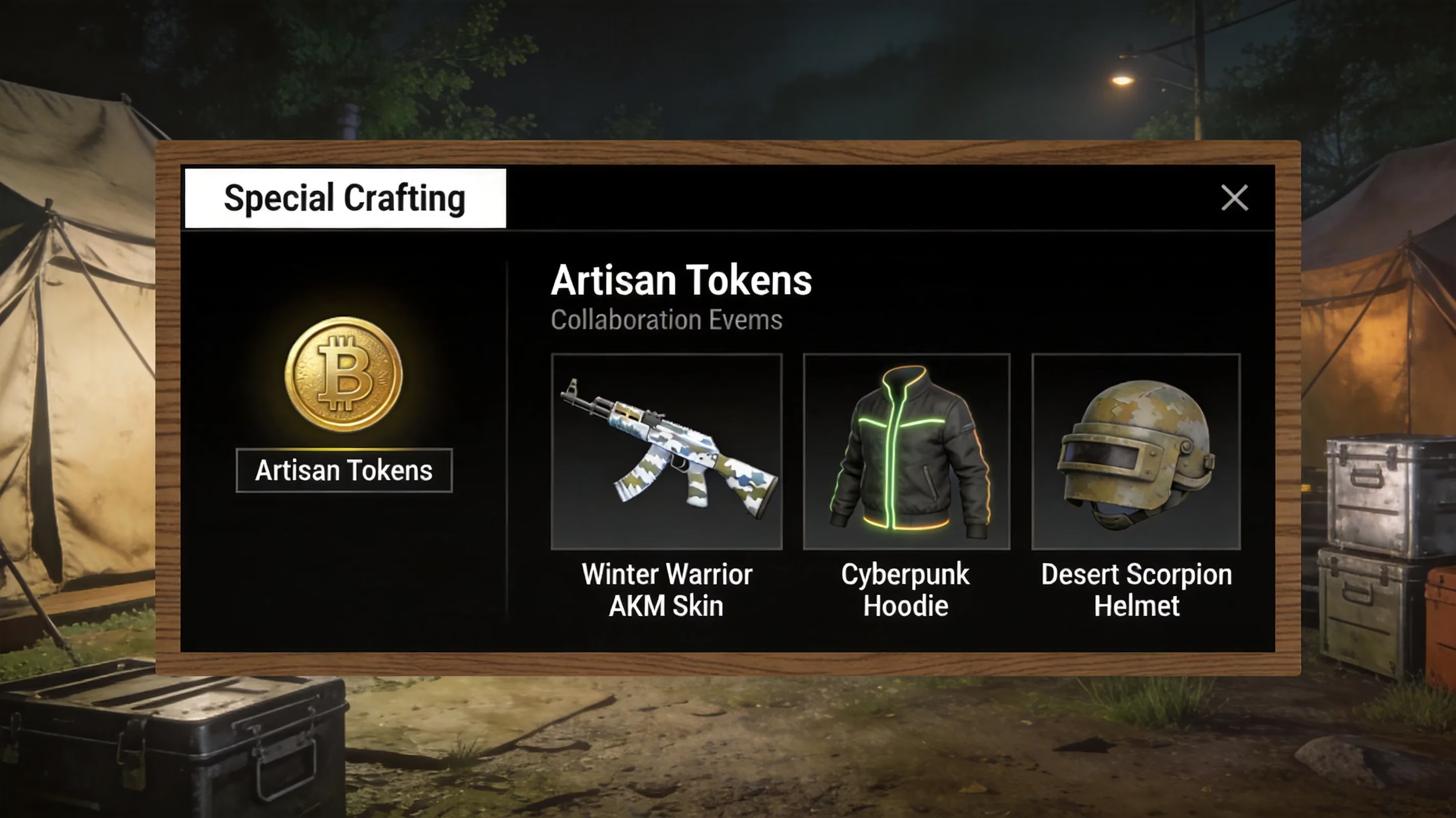
Outside of that direct exchange, the Loot Cache system acts as the main feeder. Opening collaboration-linked Loot Cache Packs gives bonus event tokens, and those tokens can then be turned into the Artisan bundle through Special Crafting. On top of that, the Currency Selection option on single-cache purchases lets you spend either G-Coin or BP, which means there is at least a technical free-to-play route, even if it's much slower. Passes also help here: things like Event Pass: Xeno Point and collab-focused Crafter Passes such as Crafter Pass: Stellar Blade award event tokens through missions and survival time, feeding straight into that same conversion loop.
PUBG Artisan Token Sources Breakdown
To really understand where Artisan Tokens come from, you have to look at the whole cosmetic pipeline in PUBG rather than just one shop tab.
Loot Cache bonus rewards are the biggest volume source. A single aespa Loot Cache Pack gives 15 aespa Tokens as a bonus. An x11 bundle gives 150 tokens, an x27 bundle gives 400 tokens plus an aespa Prime Parcel, and the x55 mega-bundle gives 800 tokens and 2 Prime Parcels. Since the Artisan x100 bundle costs 750 event tokens, that x55 purchase basically gets you there in one shot, with some extra currency left over for other crafting options.
Crafter Pass token farming is slower, but honestly, it's one of the better low-spend routes. The Crafter Pass: Stellar Blade Basic Pack cost $11.99 and gave 100 Stellar Blade Tokens immediately, then added more through pass progression. Daily missions, weekly challenges, and simple survival time all contributed. If you actually stick with the pass and grind it out, you can build enough tokens during the event period to grab Artisan x100 without needing another major store purchase.
Then there's Special Disassembly, which a lot of players overlook. If you have spare Imprints from a Prime Parcel — say from the aespa or Stellar Blade collabs — you can disassemble them in the Workshop for event tokens. A high-value Imprint like a full character set can return 375 tokens, while lower-end items like sprays give 15 tokens. This is mostly useful for players who went hard on a previous collab and are sitting on duplicate or unwanted Imprints.
| Token Source | Est. Tokens per Action | Artisan x100 Cost |
|---|---|---|
| Single Loot Cache Pack (x1) | 15 bonus tokens | 750 event tokens |
| Loot Cache Pack (x11) | 150 bonus tokens | 750 event tokens |
| Loot Cache Pack (x27) | 400 + Prime Parcel | 750 event tokens |
| Loot Cache Pack (x55) | 800 + 2× Prime Parcels | 750 event tokens |
| Crafter Pass missions + survival | Variable, 100+ base | 750 event tokens |
| Special Disassembly (set Imprint) | 375 per Imprint | 750 event tokens |
| BP purchase (single cache, up to ×50) | 15 per cache | 750 event tokens |
The difference between BP and G-Coin efficiency is huge, by the way. A single BP cache costs 10,000 BP and only gives 15 tokens, so if you're trying to fund one Artisan x100 bundle entirely through BP bonus tokens, you're looking at roughly 50 individual BP cache purchases unless you get lucky with drops or disassembly value. That's a grind. G-Coin bundles are clearly the intended fast track.
How to Use Artisan Tokens PUBG
Once you've actually got Artisan Tokens, you'll use them in the Workshop's Special Crafting section. Go to Workshop → Special Crafting, open the relevant collaboration tab, and you'll see the available craftable items. Depending on the event and current roster, that can include outfit sets, weapon skins, emotes, parachutes, and sometimes the Artisan Token x100 bundle itself as part of the wider crafting ecosystem.
The part that trips most players up is this: Artisan Tokens are not a universal direct-purchase currency for every cosmetic you see right away. If an item thumbnail shows 100 Artisan Tokens, that means the item costs that amount when the Workshop tab actually accepts Artisan Tokens as the active currency. You still need the right crafting window. In the PUBG x Stellar Blade setup, for instance, sets like NIGHT STALKER SET and END OF DAYS SET cost 700 Stellar Blade Tokens, while Artisan Token x100 cost 750 Stellar Blade Tokens. So Artisan Tokens work more like a bridge currency between collab economies and future Workshop options than a simple one-click replacement for event tokens.
One of the strongest reasons to hold them is progressive skin support. When progressive weapon skins rotate into Workshop lineups that accept Artisan Tokens, those tokens can become way more valuable than they first appear. If you're sitting on a decent stash, it's usually smart to keep an eye on future Workshop updates rather than spending them the second you get them.
There's also an important expiry detail. Collab event tokens expire much faster than Artisan Tokens do. For example, Stellar Blade Tokens expired on May 18, 2026 for PC and May 26, 2026 for Console, and once they were gone, they were gone for good. Artisan Tokens converted from those event currencies do not seem to follow the same short expiry pattern, though you should still verify in-game through the inventory's special items panel because region and platform timing can vary.
Best PUBG Artisan Token Farming Route
If you want the most efficient farming route in 2026, the sweet spot is pretty clear: active collab events plus Crafter Pass progression.
When PUBG runs overlapping collabs — like it did in April 2026 with aespa and Stellar Blade — you can farm two separate event currencies at the same time and convert both into Artisan bundles. That's a massive advantage if you're active during the event window. The Crafter Pass: Stellar Blade Basic Pack, priced at $11.99, was especially solid value because it gave 100 Stellar Blade Tokens immediately, a Stellar Blade Loot Cache, and access to pass missions. If you kept up with dailies, weeklies, and survival-time requirements, getting to around 700–800+ Stellar Blade Tokens across the event was very realistic. That's enough for one Artisan x100 bundle with room left for a few extra cosmetic crafts.
The highest token density per dollar usually comes from structured Step Up Packs during collabs. The April 2026 aespa Step Up Pack is a good example:
-
Step 1 (200 G-Coin): 60 bonus tokens
-
Step 2 (800 G-Coin): 120 bonus tokens
-
Step 3 (1,870 G-Coin): 225 bonus tokens
-
Step 4 (3,750 G-Coin): 400 tokens + a Prime Parcel
Buy through Step 4, and you end up with 805 aespa Tokens from Step Up bonuses alone. That already covers the 750-token Artisan x100 exchange, which is why these bundles tend to be the premium route for players who want speed and efficiency.
For free-to-play players, the pace drops off a lot, but it's still possible. The single aespa Loot Cache Pack could be bought with BP, up to 50 times, at 10,000 BP each, and each one gave 15 bonus tokens. On top of that, collab missions — like the PUBG x Stellar Blade event tasks tied to parachute distance, damage dealt, and survival time — handed out free Loot Cache x4 rewards. Those pulls can also feed back into your token total, either directly or through items you later disassemble.
One thing console players really should keep in mind is the schedule gap. PC gets collaboration content first, usually right after live server maintenance, while console tends to start about one week later and also ends about one week later. The Stellar Blade collab followed that exact pattern: PC started on April 8, while console access began on April 16, with later closing and expiry dates to match. If you're planning your Artisan Token farming around deadlines, that timing difference matters a lot.
PUBG Artisan Tokens Value and Crafting Priority
Getting Artisan Tokens is one thing. Spending them well is the part that actually saves you from wasting value.
Best redemptions first: if you're looking at a collab tab where a costume set costs 700 collab tokens, but converting to Artisan Token x100 costs 750 collab tokens, the direct math usually doesn't favor the Artisan route. In most cases, you should only go for the Artisan bundle if you already grabbed the cosmetics you really wanted and you're left with extra collab tokens that would otherwise expire.
That leads into the real question: Artisan Token vs. direct crafting. Spending 750 Stellar Blade Tokens on an Artisan bundle only makes sense when the item you want later is available only through Artisan Tokens and not through the current event currency. If your target cosmetic costs 100 Artisan Tokens and there isn't a direct collab-token alternative that fills the same role, then the conversion starts to look worthwhile.
Saving tokens is often the smarter play. If the current Workshop doesn't offer an Artisan-priced item you care about, holding your Artisan Tokens for a future rotation is usually better than forcing a craft. Since collab event tokens have hard expiry dates, converting spare event currency into Artisan Tokens before the deadline is a solid salvage move. They appear to hold value much longer.
A few purchases are pretty easy to skip. These are the weak-value options in most collab Special Crafting menus:
-
Key Fragments for 20 tokens
-
Single Keys for 60 tokens
-
Key x3 bundles for 180 tokens
Those items only help open Contraband Crate slots and don't guarantee any meaningful cosmetic return. If you're trying to maximize value, your tokens are almost always better spent on character sets, weapon skins, or Artisan Token bundles instead.
PUBG Artisan Tokens FAQ
Why can't 100 Artisan Tokens be used to craft anything?
Because the 100-token price on an item doesn't mean it's always active and craftable. It only means that's the cost when a Special Crafting tab is currently using Artisan Tokens as the accepted currency. If no live tab supports Artisan Token input, those tokens just sit in your inventory until a compatible Workshop rotation appears. That's probably the single biggest point of confusion around the system.
Why is token expiry so confusing?
Because PUBG treats collab tokens and Artisan Tokens differently. Event currencies like aespa Tokens and Stellar Blade Tokens usually expire shortly after the collab ends. Artisan Tokens, on the other hand, seem to stick around much longer and may not share the same aggressive expiry rules. Still, you should always check the in-game inventory panel for the exact timer, since KRAFTON has adjusted these details across patches before.
Is there a PC vs. console difference?
Yes, mostly in timing. In 2026, major collabs have consistently launched on PC first, then on console about a week later, with console end dates also shifted back by around a week. Functionally, the event length is similar, but console players get a later start and need to pay attention to their own platform-specific deadlines rather than following PC dates blindly.
Can you get free Artisan Tokens in PUBG?
Yes, but only indirectly. You can use BP for single Loot Cache purchases, and those give small event-token bonuses. Free collab missions also hand out cache rewards without needing G-Coin. If you buy a low-cost pass like a Basic Pack Crafter Pass, you can add mission-based token income on top. A true zero G-Coin route does exist through BP and free event rewards, but it is slow, and you usually won't build Artisan Tokens quickly unless you have enough spare collab currency to convert.
Conclusion
The most reliable way to get Artisan Tokens in PUBG: BATTLEGROUNDS is still through collab-event Special Crafting, where 750 event-specific tokens — whether from aespa, Stellar Blade, or future crossover events — can be exchanged for an Artisan Token x100 bundle in the Workshop. If you want the fastest route, Loot Cache bundles and Step Up Packs give the highest token density, while Crafter Pass grinding and free event missions offer a slower but cheaper path.
As for spending, Artisan Tokens are at their best when used on Workshop items that your original collab currency can't buy directly. They're a lot less appealing if you're sacrificing a high-priority costume set just to convert. Keep a close eye on event deadlines, double-check platform timing if you're on console, and never let collab tokens expire without deciding whether an Artisan conversion is worth it. Happy hunting, survivors.